Canasta Online – Card Game
Spiele-Palast GmbHCard
4.3465.00 Reviews
- Version
- 2026.2.0
- Installs
- 500.00K
- Age Rating
- Teen
Screenshots


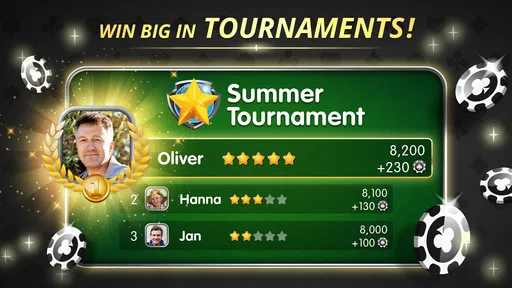
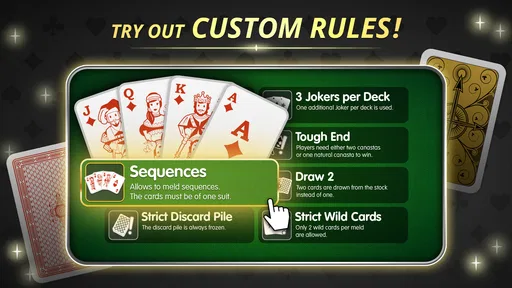
Our Review of Canasta Online – Card Game
 Analysis by Appyee
I enjoy card games most when the rules are familiar but the people at the table keep every round unpredictable. Canasta Online – Card Game takes that approach and puts it into a focused mobile format. It is a free card game from Spiele-Palast GmbH, built around online canasta matches with real players rather than computer-controlled opponents. After spending time with it, I found the main appeal is not flashy presentation or a huge collection of modes. It is the feeling of sitting down for a proper partnership game whenever I have a few uninterrupted minutes.
That focus makes the game easy to understand, but not automatically easy to master. Canasta rewards memory, patience, communication with a partner, and careful decisions about when to take risks. A weak hand can become useful if I manage it well, while a tempting play can create problems several turns later. The mobile format makes those decisions convenient, although it also means that connection quality, attention, and the behavior of other players matter more than they would in a casual offline game.
How a normal match feels from the first deal
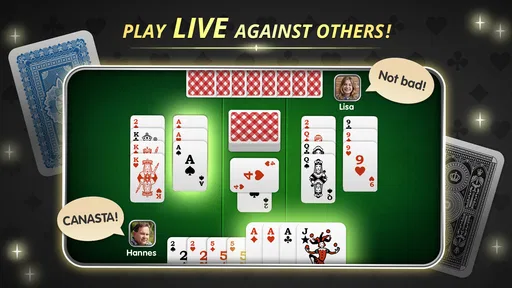
The baseline workflow is straightforward. I open the game, look for an online table, and prepare to play against people rather than bots. That distinction shapes the entire experience. A human opponent may hesitate, change pace, or make an unexpected discard, and a partner may interpret the situation differently from me. Those small uncertainties are exactly what keep a familiar card game from feeling like a puzzle with a fixed solution.
For a newcomer, the best approach is to treat the first matches as practice in reading the table rather than chasing every possible scoring opportunity. I pay attention to the cards being discarded, the sets that opponents appear to be collecting, and whether the discard pile is becoming dangerous to pick up. The game becomes much clearer once I stop viewing each card in isolation and start asking what information my play gives to everyone else.
That is especially important in partnership play. A move can be individually attractive but harmful to the team if it gives the opponents a useful card or leaves my partner with no practical way to continue. Since online tables involve real people, I also try to keep my decisions reasonably consistent. I do not expect strangers to understand an elaborate personal system, so I favor clear, conventional choices over clever-looking plays that depend on an imagined signal.
A realistic everyday use case is a short break after work. I can begin a match when I have enough time to concentrate, but I would not start one while waiting for a bus that may arrive at any moment. Even if the opening turns are relaxed, later decisions can require attention, and leaving at the wrong moment affects a partner who has no control over my schedule. The game works best when I reserve it for a small, deliberate pause rather than treating it like a game that can always be abandoned without consequences.
The free entry point is helpful here. I can try the actual multiplayer experience before deciding whether it belongs in my regular rotation. The store listing places the game at a 4.3 average from around 7,100 ratings, with more than 500,000 installs. Those figures suggest a healthy audience for this particular style of online card play, and I found that the human-table focus gives it a different character from solitaire apps or card games built mainly around scripted opponents.
What to learn before trying to play quickly
My first practical tip is to slow down during the opening of a match. Early discards reveal more than they seem to. If I immediately throw away cards without considering what the other side may need, I can accidentally make their next turn easier. I also avoid assuming that a visible pattern tells the whole story. A player may be collecting one group while quietly holding cards for another, so I use the table as evidence rather than certainty.
The second habit is to separate short-term gain from end-of-round value. Taking a large discard pile can feel exciting, but it may also bring unwanted cards into my hand and expose my intentions. I ask whether the pickup creates a useful set, protects a needed card, or merely gives me more cards to manage. That question is more reliable than reacting to the size of the pile alone.
The third is simple but easy to neglect: I keep track of which ranks have already appeared. I do not try to memorize every card perfectly. Instead, I remember the few ranks that matter to my current plan and the cards that could make an opponent’s discard pile especially attractive. This lighter form of memory is realistic on a phone and reduces mental overload during longer matches.
Settings, habits, and the small choices that improve play
Before settling into regular games, I recommend checking the available settings and interface controls rather than accepting every default. I look for anything that affects sound, notifications, visual clarity, or how comfortably the table can be read. I do not treat these as cosmetic details. A distracting alert or unclear audio cue can make me rush a decision, while a quieter setup helps me notice the discard sequence and stay focused on my partner’s position.
I also make sure the phone is in a state that suits a complete match. Battery saving, unstable mobile data, or a crowded notification panel can turn a thoughtful game into a stressful one. This is not a special trick inside the app; it is a repeatable preparation habit that matters because the game depends on a live table. If I know I may lose signal, I wait rather than join and hope the connection recovers.
For accessibility and comfort, I spend a few minutes deciding whether the cards and table information are easy to distinguish on my screen. Card games involve repeated visual scanning, so eye strain becomes noticeable before the rules do. I prefer a brightness level and text size that let me read without holding the phone unusually close. If the interface feels cramped on a smaller display, a larger phone or tablet may be a better choice than trying to compensate by playing faster.
Notifications deserve a deliberate decision too. I like reminders that help me return to a game when appropriate, but I do not want every interruption to pull my attention away from another task. Because a match involves other players, I would rather disable unnecessary distractions before joining than discover halfway through that I cannot concentrate. This is one reason I see the game as a focused activity instead of a background pastime.
The current version is 2026.2.0 and supports devices starting with Android 7.0. That makes it approachable for people who do not use a recent phone, although performance and screen comfort can still vary with the device. I would judge the experience by how smoothly the table remains readable and responsive on the phone I actually use, not simply by the operating-system requirement.
Repeatable patterns for making better decisions
Experienced play is less about finding one magical move and more about repeating a sound process. I begin by identifying the cards I genuinely want, then I consider what my discard communicates. If I am holding several possibilities, I prefer to preserve flexibility until the table gives me more information. This prevents me from committing too early to a plan that an opponent can easily disrupt.
Another useful pattern is to review the table after every meaningful change. When a player takes the discard pile, completes a set, or changes the apparent direction of play, I mentally reset my assumptions. I do not continue following a plan simply because it worked two turns earlier. The ability to update quickly is more valuable than defending an earlier idea.
When playing with a partner I do not know, I keep my choices legible. I avoid relying on subtle signals that may not be understood, and I try to make moves that preserve useful options for the team. This does not mean playing timidly. It means recognizing that a partnership game has two decision-makers, so a move that looks brilliant from my hand may be poor if it leaves the other hand impossible to use.
I also watch the pace of the table. A quick player may be confident, impatient, or simply familiar with the interface; a slower player may be thinking carefully or dealing with a distraction. I do not treat speed as proof of skill. My own target is steady play: read the cards, check the consequences, and confirm the intended action before tapping. On a touchscreen, that final pause helps avoid mistakes caused by selecting the wrong card under pressure.
A less obvious trade-off is information versus flexibility. Holding cards for too long can conceal my plan, but it can also clog my hand and prevent useful combinations from forming. Discarding early may reveal less than I fear if the card has little value to either side. I make that judgment based on the current table, not on a blanket rule such as always hiding pairs or always discarding high cards.
Where the online format creates friction
The strongest part of this game is also its main limitation: real opponents make matches lively, but they make the experience less predictable. I cannot expect the consistency of a bot or the convenience of an offline practice mode. A partner may play in a way I would not choose, and an opponent may make a move that seems strange until its purpose becomes clear. Players who want a calm solo card game may be happier with a traditional offline canasta app.
The same applies to people who dislike waiting or who often play in places with unreliable connectivity. Online card games are only enjoyable when the table can progress at a reasonable rhythm. I would not choose this as my main option if I want to pause freely, experiment without social pressure, or play without depending on other participants.
There is also a financial point worth considering. The game is free to download, but in-app purchases range from $0.69 to $420.19 per item. That wide range means I would review the purchase screen carefully and avoid tapping through quickly, especially if a younger person uses the device. The Teen content rating is another reason families should treat the game as an online social card experience rather than assuming it is intended for children.
I do not see purchases as a reason to dismiss the game outright, but they are a reason to establish a personal boundary before playing regularly. Someone who wants a completely purchase-free experience may prefer a paid offline alternative with no online economy. Someone who values live tables and is comfortable ignoring optional spending may find the free starting point more appealing.
How it compares with familiar alternatives
Compared with solitaire, this game offers far more social tension and less control over the pace. Solitaire is excellent when I want a private, predictable session that can be paused at any moment. Canasta Online is better when I want to read other people, adapt to changing decisions, and feel that a win came from both planning and interaction.
Compared with offline canasta, the advantage is access to human opponents without arranging a physical table. I can practice decision-making against varied styles instead of facing the same programmed behavior. The cost is that I give up some convenience: a live match requires a suitable connection, enough attention, and patience with people whose playing habits differ from mine.
Compared with broad multiplayer card platforms, this title feels more focused because its identity is tied to canasta rather than a large menu of unrelated games. That is a strength for someone who already enjoys this ruleset and wants to improve through repetition. It is less suitable for a player who wants poker, rummy, solitaire, and several other formats in one application.
The developer, Spiele-Palast GmbH, has positioned the experience around the table itself rather than turning it into a collection of distractions. I appreciate that focus, but it also means the game cannot rescue a player who does not enjoy canasta’s slower, more deliberate rhythm. The rules and social format have to be part of the appeal from the start.
Who should play and what mastery really requires
I recommend Canasta Online – Card Game to players who already know the basics of canasta, people looking for regular online opponents, and friends who want to meet around a familiar card game without sharing the same room. It is also a good fit for someone willing to improve through observation rather than expecting a tutorial to solve every strategic question. The free price makes trying it easy, while the live format gives repeated matches more variety than a fixed solo challenge.
I would steer away from it if your ideal card game is entirely offline, instantly pausable, or free from any purchase prompts. I would also choose something else for a very young player, since the content rating is Teen, or for anyone who becomes frustrated when teammates and opponents do not follow an expected style. The game asks for a little social patience in addition to card knowledge.
For mastery, I would build a routine around three checks: identify the useful cards in my hand, read what the discard pile is telling me, and consider what my move leaves for my partner. I would review mistakes after the round instead of judging a play only by whether it won immediately. Over time, this creates a more reliable sense of when to protect information, when to take a calculated pickup, and when to abandon a plan.
The final limitation is that no setting or shortcut can replace attention. Interface preparation can make a table easier to read, and repeatable habits can reduce careless errors, but the decisive work still happens in the choices between turns. That is why I find the game satisfying: it does not pretend that a quick tap is the same as good play.
My verdict is positive, with a clear condition: choose it for live canasta, not for a generic casual card diversion. The focused multiplayer design, real-player tables, and free entry give it a strong reason to exist on mobile. Its online dependence, variable table behavior, Teen rating, and broad in-app purchase range mean it is not perfect for every player. For me, though, it succeeds when I prepare properly, play with enough time to think, and treat each match as a partnership conversation carried out through cards.
Verdict
Strengths of Canasta Online – Card Game
- Smooth online multiplayer matches with players worldwide.
- Simple rules make it approachable for beginners.
- Private tables let you play with friends or family.
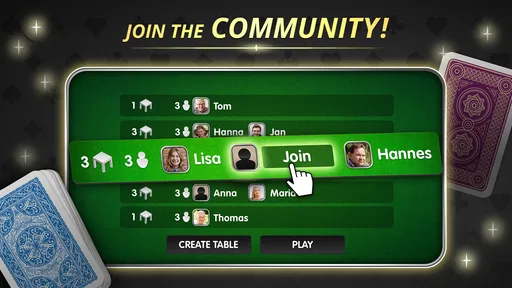
- Quick matchmaking helps you start games without much waiting.
- Progress tracking makes it easy to monitor your performance.
Limitations of Canasta Online – Card Game
- A stable internet connection is required for online matches.
- Match quality may vary depending on your opponents.
- Ads can interrupt the experience in the free version.
- Some features may require in-app purchases or premium access.
- Learning advanced scoring strategies can take time for new players.
Similar Picks in This Category
View All
Solitaire - Classic Card Games
MobilityWare4.6

UNO!™
Mattel163 Limited4.3

Spider Solitaire: Card Games
MobilityWare4.6

Solitaire.com - Classic Cards
Tripledot Studios Limited4.7

Plants vs. Zombies™ Heroes
ELECTRONIC ARTS4.1

Hearthstone
Blizzard Entertainment, Inc.4.1
Frequently Asked Questions
What is Canasta Online – Card Game?
Canasta Online – Card Game is a digital version of the classic rummy-style card game, designed for playing on mobile devices. It generally allows you to compete against computer-controlled opponents or other players online, depending on the available modes. The main objective is to form melds, especially groups of seven cards called canastas, while carefully managing the cards in your hand and the discard pile.
How do you play Canasta Online – Card Game?
The game is usually played with two standard decks, including jokers, and players take turns drawing cards, creating valid combinations, and discarding one card. Number cards and face cards have different point values, while wild cards can help complete melds. Before downloading, remember that exact rules, scoring, team formats, and minimum requirements for going out may vary according to the selected game mode or app settings.
Can I play Canasta Online – Card Game with real people?
Yes, the online version is primarily intended for multiplayer entertainment, allowing you to challenge other players through internet-based matches. Some versions may also include private rooms, invitations, matchmaking, rankings, or team games. The quality of the experience depends on the size of the active player community and your internet connection, so available opponents and waiting times may differ by region and time of day.
Does Canasta Online – Card Game require an internet connection?
An internet connection is normally required for online matches, account features, matchmaking, leaderboards, and other multiplayer functions. The app may offer an offline mode against artificial intelligence, but this depends on the specific version and device. If offline play is important to you, check the game description and permissions before installing, because some releases may require a connection even when you are playing alone.
Is Canasta Online – Card Game free to download and safe for children?
Canasta Online – Card Game may be free to install, but it can include advertising, optional purchases, premium features, or other limitations that vary between Android and iOS versions. Because it involves online interaction, usernames, chat, or competitive rankings may be present. Parents should review the age rating, privacy policy, in-app purchase settings, and communication options before allowing younger players to use the app.
Play our best games!


